How Levels Work in ZooBlocks
ZooBlocks levels mix five hand-designed teaching levels with procedural goals after that, a board that grows from 4×4 to 9×9, and a zoo that activates after your first clear. Here is the whole system, with the exact numbers behind it.
The First Five Levels Teach Everything
Levels 1 through 5 are hand-designed, one mechanic each:
- Level 1 — clear one row.
- Level 2 — clear one column.
- Level 3 — score 5,000 points.
- Level 4 — pop 15 animals.
- Level 5 — clear one row and one column in the same level.
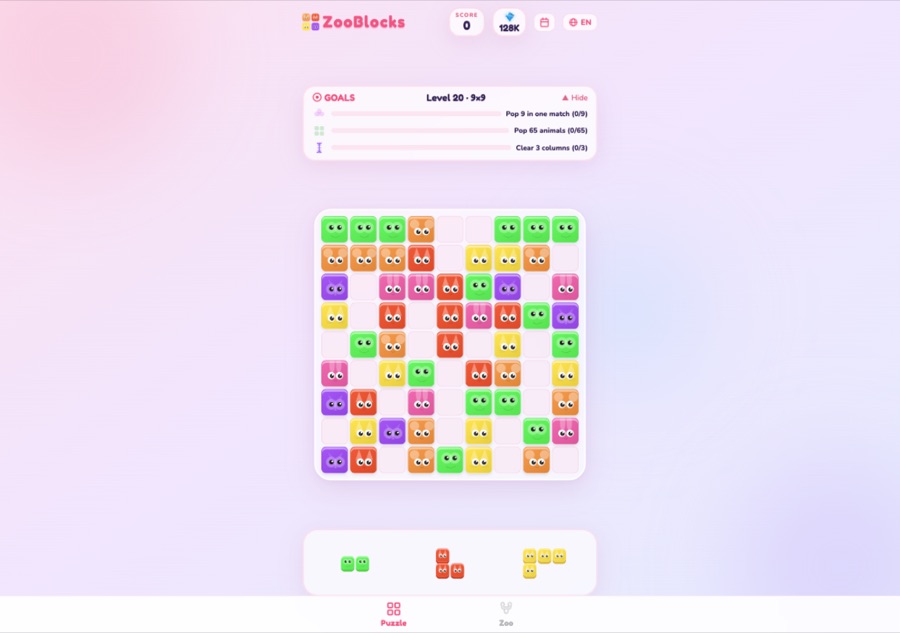
From level 6 on, goals are generated: each level draws two objectives from a weighted pool, and from level 15 the generator mixes in a third goal on every fifth level.
Board Growth, Level by Level
- 4×4 — levels 1–2 (16 cells)
- 5×5 — levels 3–4 (25 cells)
- 6×6 — levels 5–7 (36 cells)
- 7×7 — levels 8–10 (49 cells)
- 8×8 — levels 11–14 (64 cells)
- 9×9 — level 15 and every level after (81 cells)
The board can only grow so far, but goal quotas keep scaling with level, capped at difficulty 60 so late levels stay challenging rather than absurd. The Board Size guide covers the strategy shift at each size.
The Zoo Activates at Your First Clear
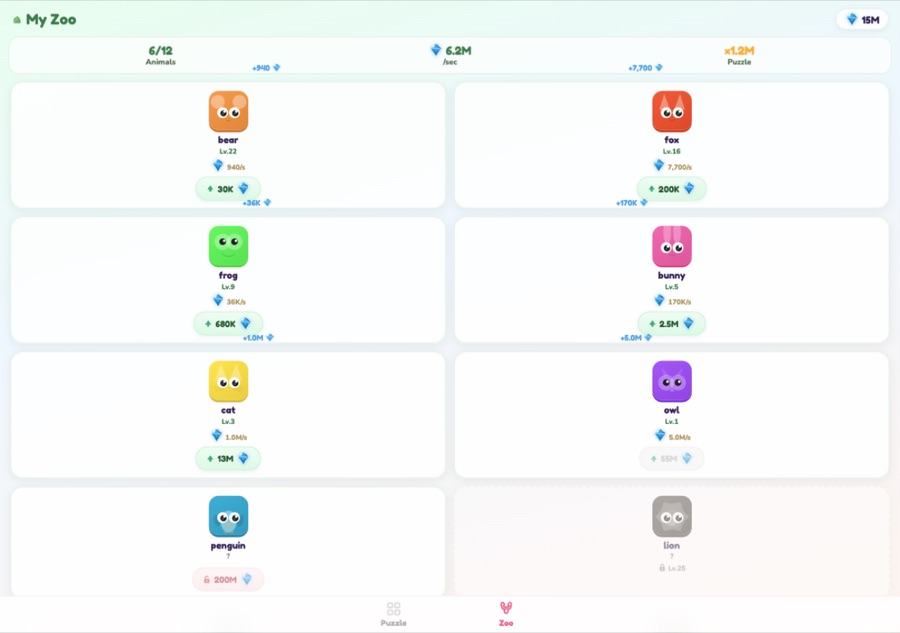
Clearing level 1 unlocks the zoo tab and the diamond counter. Diamonds pile up from every level you finish (or fail), and the zoo shop lists animals gated by level. Each newer tier costs roughly ten times more and earns roughly ten times more than the previous one.
- Fox - zoo shop at level 3
- Frog - level 5
- Bunny - level 7
- Cat - level 10
- Owl - level 14
- Penguin - level 19
- Lion - level 25
- Turtle - level 31
- Monkey - level 39
- Elephant - level 47
- Dragon - level 56
Animals keep earning while the game is open, and their income feeds back into puzzle rewards through the diamond multiplier — income per second divided by five.
Why the Curve Feels Different
Most puzzle games hand you a fixed board and endless levels with no texture. ZooBlocks instead paces three change axes at once: goal mix (new goal types join the pool as levels rise), board size (six phases from 4×4 to 9×9), and economy (each animal tier roughly ×10 output). Because the three axes unlock at different rhythms, no two stretches of the ladder feel identical.
Practically, that means checking off three things in order: learn the pieces in the first five levels, learn the goal quota logic through the mid boards, and start serious zoo planning once two or more animals sit behind you. The Level Goals guide explains the first two, and the Animals guide covers the third.
Score Goals You Will Actually Meet
The score goal formula is (board cells × 200) + (1,500 × level difficulty), rounded to the nearest thousand. Real examples from the live generator:
- Level 3 (5×5 board): 25 × 200 + 0 = 5,000 — the first scoring goal.
- Level 6 (6×6 board): 36 × 200 + 7,500 = 14,700, rounded to 15,000.
- Level 20 (9×9 board): 81 × 200 + 28,500 = 44,700, rounded to 45,000.
Compare those with typical achieved scores: a single ×8 turn on an early board already pays 8,400, so a level-6 score goal converts into roughly one big overlap turn plus normal play. The goals are tuned so that one great turn closes half of a score objective — that is the design intent you should exploit.
What Happens When a Level Ends
- Clear: a banner and a result card show the level score, turn stats, the diamond reward (score × your zoo multiplier), and the next level's board size plus its new goals — you can read the next challenge before committing.
- Fail (no pieces fit): the level score still converts into diamonds at the same rate; the run simply stops. Failing never erases zoo progress or streak state.
- Goal memory: generated goals are cached, so replaying the same level number presents the same objectives — useful for planning color-pop goals in advance.
- Score resets per level: the header score shows the current level only; your total score and best score are tracked separately.
Ready to Play?
Everything you read here is already live in the game — your browser is the only thing you need.