Strategy Tips for Better ZooBlocks Runs
Strong ZooBlocks play is two layers deep: short-term board control in the puzzle, and disciplined zoo investment over weeks of play. The best players do both at once — this page collects the tactics that actually move the needle.
Protect Space First
- Build from the edges inward so the center remains flexible for bulky shapes.
- Never seal a one-cell hole between filled cells — the game ends on trapped singles more than on full boards.
- Treat long straight pieces as cleanup tools: placed early, they waste the shape; placed late, they finish two lines at once.
- Keep at least one quadrant "low" — half-cleared — where fat shapes can breathe.
Plan the Whole Tray
The tray only refills after all three pieces are placed, so each tray is a mini-puzzle with its own solution, visible from the first preview. Before touching anything, decide what each piece is for: which finishes a line, which feeds a cluster, which dies into the least-bad gap.
Order matters: bulky 4-to-5-cell pieces are cheapest to place early, when the board still has partial empty space in several quadrants. Singles and dominoes hold their value all run — they fit the one-cell holes that big pieces create, so they are often worth holding into the next tray.
Build for Overlap Turns
The strongest pattern in the game: leave one cell open in a nearly full line while a same-animal group grows beside it, then finish both with one placement. To set it up:
- Place two same-animal cells near the open line gap (the pop needs at least one older cell — three adjacent from one piece never pop alone).
- Wait for a tray piece that covers the gap with the pop color.
- Finish both: the line pays its multiplier and the pop adds on top — cells in both systems count twice.
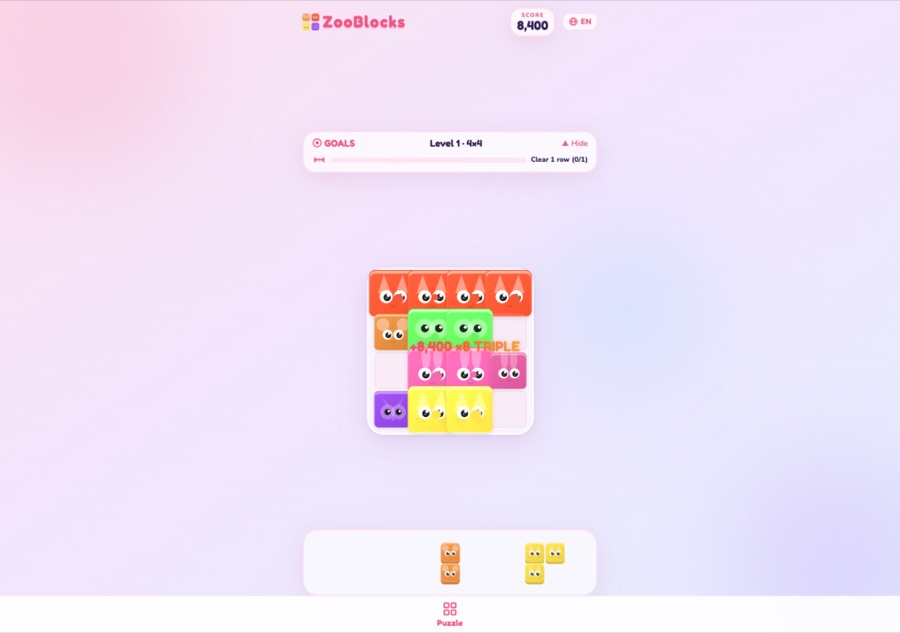
Worked example: a fox placed to complete a fox row while two columns are full clears 10 cells — 8,000 line points at ×8 plus 400 pop points, 8,400 in one placement. The Scoring guide breaks the full math down.
Chase the Multiplier Ladder
Line clears double per additional simultaneous line. One line pays ×2. Saving one line for a two-line turn is already +100% on its cells. The jump keeps compounding: ×4, ×8, ×16, ×32. A healthily built 9×9 board can finish with three lines at once several times in a run, and that scaling is where the big level scores come from.
Why not clear everything immediately? Because each turn's line total determines the multiplier. Clearing proud rows alone pays the board tax; banking lines for combined finishes pays compounding interest. The balance: clear enough to survive, hold enough to profit.
Spend Diamonds With Discipline
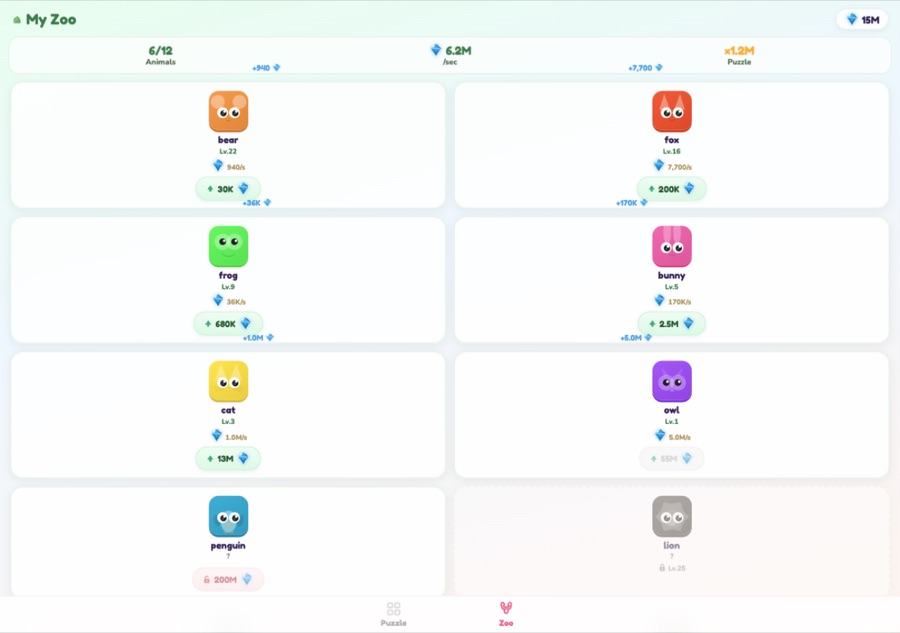
The zoo ladder runs bear → fox → frog → bunny → cat → owl → penguin → lion → turtle → monkey → elephant → dragon. Costs scale roughly ×10 per tier, and so does income. Two rules keep your economy on the good side of that curve:
- Buy the newest animal you can realistically afford. It usually out-earns several older upgrades combined.
- Upgrade cost is (10 + level) × current income. Early levels are cheap; by level 20+ the same animal costs 30× its income for one step. When your newest animal's income is 10× the older one's, the math answers itself.
A developed mid-game zoo (bear at 22, fox at 16, frog at 9, four more animals owned) earns over 6M diamonds per second — that economy is what multiplies your future level scores at the zoo rate, not the base rate. Each diamond spent where the growth percentage is highest pays forever after.
Use Daily Challenges Correctly
Daily quests scale with zoo income (each pays roughly income/second × 1,000 ÷ 6, minimum 500, split across three quests). The design intent: daily play stays valuable, but the quests should not dictate reckless play.
- If a quest matches current level goals, do it first — the two reward streams stack.
- If a quest fights survival (a deep score target on a bad board), clear levels normally and bank the quest partially.
- Streaks matter: the claim resets at local midnight, so a two-minute single-level session keeps a streak alive if the day gets busy.
When the Run Ends
Runs end when the tray cannot fit anywhere. Two endgame notes:
- Once only awkward singles remain, stop saving them — place what clears most even at a bad multiplier.
- Failing a level still banks diamonds for the score you earned, so late-run risk-taking is cheap insurance, not a loss.
Ready to Play?
Everything you read here is already live in the game — your browser is the only thing you need.